
When Anxiety Meets Faith: What Tawakkul Really Means for Muslim Women
Tawakkul doesn’t mean stop worrying — it means trust deeply and act fully. An honest exploration of faith and anxiety for Muslim women.
بِسْمِ اللَّهِ الرَّحْمَنِ الرَّحِيم
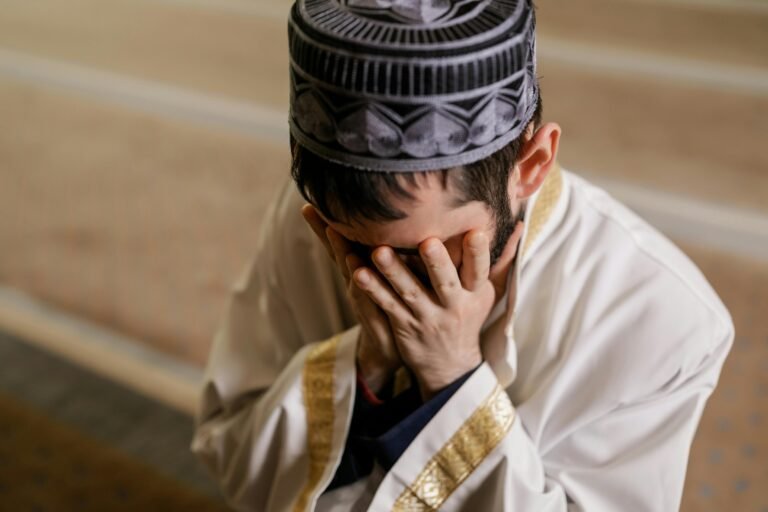
Someone in your life has probably said it. Perhaps you have said it to yourself. You share that you are anxious, that your mind will not stop, that the what-ifs are keeping you awake at 3am — and you receive: “Just have tawakkul. Trust Allah. If your iman was stronger, you wouldn’t feel this way.”
And something in you deflates. Because you do have iman. You do try to trust Allah. And the anxiety is still there, coiling quietly in your chest during salaah, loud and relentless at night. So what does that say about you?
Here is what it says: you are human. And tawakkul has been fundamentally misrepresented.
What tawakkul is not
Tawakkul is not the absence of anxiety. It is not the suppression of fear. It is not a state of perpetual spiritual calm that descends upon those whose iman has reached a certain level. It is not passivity dressed in Islamic clothing.
If tawakkul required the absence of fear, the Prophet ﷺ — who was told by Allah Himself:
إِنَّا سَنُلْقِي عَلَيْكَ قَوْلًا ثَقِيلًا
“Indeed, We will cast upon you a heavy word.” (Al-Muzzammil, 73:5)
— would have been exempt from anxiety. He was not. He experienced fear, distress, and the weight of an enormous mission. His companions experienced terror in battle, grief in loss, and uncertainty in hardship. Iman did not eliminate their human nervous systems. It gave them something to hold onto while those systems fired.
What tawakkul actually means
The word tawakkul comes from the root wakala — to appoint someone as your agent, to delegate to them, to rely upon them fully. When we make tawakkul upon Allah, we are saying: I appoint You as the One who handles what I cannot. I act fully with what I have been given, and I leave the outcome in Your hands.
This is made vivid in one of the most misunderstood hadith in Islamic discourse. A Bedouin came to the Prophet ﷺ and asked whether he should tie his camel or simply rely on Allah. The Prophet ﷺ replied:
“Tie it and then put your trust in Allah.” (Tirmidhi)
Tawakkul is not either/or. It is both/and. Take the practical step — make the appointment, study for the exam, get the diagnosis, seek the counsellor, do the therapy — and then release the outcome to Allah. Anxiety often intensifies when we believe it is our job to control outcomes. Tawakkul frees us from that impossible task.
Your body is not sinning when it feels anxious
The human nervous system was designed by Allah. The fear response — the racing heart, the tight chest, the spiralling thoughts — is a survival mechanism built into the most extraordinary creation in the universe: you. It is not a malfunction. It is not a moral failure.
The Prophet ﷺ’s heart raced on the night of the first revelation. Musa (AS) asked Allah to steady his tongue before facing Pharaoh — a request rooted in the very human experience of fear in a high-stakes situation. Anxiety, in its natural form, is your body trying to protect you. It becomes a problem when it becomes chronic, disproportionate, and interfering with your life — and at that point, it deserves care, not shame.
Tawakkul as a growth practice
This is why tawakkul belongs in the Self-Growth category: it is a practice, not a passive state. It is something you build, day by day, through deliberate choices.
The first movement is action. Do the thing you are afraid of, as much as you are able. Take the step. Make the phone call. Have the conversation. Anxiety shrinks when it is met with action rather than avoidance. Act, then release.
The second movement is surrender. After action comes the deliberate handing-over of outcomes. This requires a specific, repeated internal practice — something like: “I have done what is mine to do. The rest belongs to Allah. I trust His judgement more than my own.” Say this out loud if you need to. Write it down. Your mind needs to hear it many times before it begins to believe it.
The third movement is remembrance. Zikr — the remembrance of Allah — is clinically significant. The rhythmic repetition of Subhanallah, Alhamdulillah, Allahu Akbar genuinely calms the nervous system. It is not coincidence that Allah placed the cure for the anxious heart in the same act:
أَلَا بِذِكْرِ اللَّهِ تَطْمَئِنُّ الْقُلُوبُ
“Verily, in the remembrance of Allah do hearts find rest.” (Ar-Ra’d, 13:28)
Start with five minutes of zikr after fajr. Notice what it does to the quality of your morning.
The freedom that tawakkul actually offers
When you genuinely internalise tawakkul — not as a performance of calm but as a real conviction that Allah is in charge of outcomes — something extraordinary happens. You become free to act fully. You can try things. You can take risks. You can step into the uncertain, the uncomfortable, the unknown — because the outcome is not on your shoulders. It is in His hands.
وَمَن يَتَوَكَّلْ عَلَى اللَّهِ فَهُوَ حَسْبُهُ
“And whoever relies upon Allah — then He is sufficient for him.” (At-Talaq, 65:3)
He is sufficient. Not your worry. Not your control. Not your endless attempts to predict and prevent every possible bad outcome. Him.
Journaling prompts for reflection
- What outcome in your life right now are you trying to control that is genuinely outside your control? Write it down and then write: “I have done what is mine. The rest belongs to Allah.”
- In what ways has anxiety actually helped you — and in what ways has it limited you? What would your life look like with the helpful part and without the limiting part?
- Think of a time when something you were anxious about turned out differently — better or more nuanced — than you feared. What did that experience teach you about trusting what you cannot see?
- What practical step have you been avoiding because of anxiety? What is the smallest possible version of that step you could take this week?
A closing du’a
اللَّهُمَّ إِنِّي أَسْأَلُكَ الثَّبَاتَ فِي الأَمْرِ، وَالْعَزِيمَةَ عَلَى الرُّشْدِ، وَأَسْأَلُكَ شُكْرَ نِعْمَتِكَ، وَحُسْنَ عِبَادَتِكَ
Allahumma inni as’aluka-thabata fil-amri, wal-‘azimata ‘alar-rushdi, wa as’aluka shukra ni’matika, wa husna ‘ibadatika.
“O Allah, I ask You for steadfastness in all matters, and determination upon the right path, and I ask You to be thankful for Your blessings and to worship You well.”
May your anxiety become the very soil from which your tawakkul grows — and may you discover that when you stop trying to hold everything, you are held. آمين