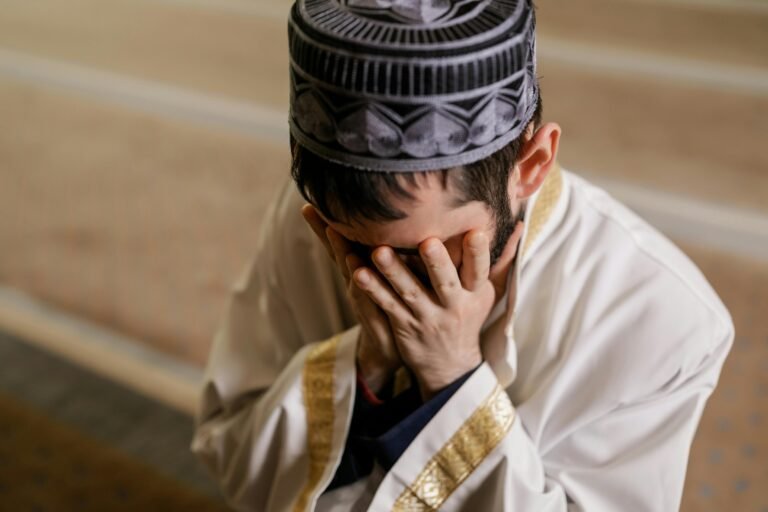

When Grief Meets Iman: Processing Loss Through an Islamic Lens
Grief does not announce itself. It arrives uninvited in the middle of Fajr, in the silence after dinner, in a scent that carries a person you can no longer reach. And when it comes, it often brings a companion question no one prepared us for: How am I supposed to feel this and still hold on to Allah?
Islam Does Not Ask You to Stop Feeling
One of the most powerful moments in prophetic history is the day the Prophet Muhammad (peace be upon him) wept over the death of his son Ibrahim. His eyes filled with tears, and when a companion questioned him, he replied:
“The eyes shed tears and the heart feels pain, but we do not say anything except that which pleases our Lord.” (Bukhari)
This hadith is revolutionary. It holds three truths simultaneously: grief is real, grief is allowed, and grief does not have to contradict iman. The Prophet cried. He felt the heaviness of loss. And he remained a man of tawakkul, complete reliance on Allah. These are not opposites.
The Quran Honors the Grieving Heart
When Prophet Yaqub (AS) lost his son Yusuf, he did not simply move on. He wept until he lost his sight. He said: “I only complain of my suffering and my grief to Allah.” (Quran 12:86). Allah recorded this grief in the Quran — not as a failure of faith, but as a testimony of the depth of human love and divine intimacy.
Grief, in the Islamic worldview, is not spiritual weakness. It is the cost of love. And love — even love that aches — is one of the most beautiful gifts Allah places in the human heart.
“I only complain of my suffering and my grief to Allah.”
— Prophet Yaqub (AS), Quran 12:86
Stages of Loss Through an Islamic Lens
Modern psychology identifies stages of grief, denial, anger, bargaining, depression, acceptance. While these can be useful frameworks, Islam offers its own vocabulary for navigating loss:
Inna lillahi wa inna ilayhi raji’un — “Indeed, we belong to Allah, and indeed to Him we shall return.” (2:156). This phrase, spoken at news of death, is not a suppression of grief. It is an anchor. It reminds the grieving heart of the ultimate context of this life: we are all in transit, and all returns to its origin.
Sabr, Patience — is often misunderstood as stoicism. But authentic sabr is not about not feeling. It is about choosing not to despair. It is the quiet, sustained effort to stay tethered to Allah even when the rope feels thin.
Du’a, Supplication — is perhaps the most healing Islamic practice in grief. The act of pouring out your pain to Allah is itself an act of tawheed: the acknowledgment that He alone hears, sees, and can heal.
Practical Islamic Healing Practices
If you are in grief right now, here are some Islamic anchors to return to:
1. Allow the tears. The Prophet (SAW) taught us that mercy is shown to those who are merciful — and that includes being merciful with yourself. Crying is not weakness; it is a form of release that Allah built into the human body.
2. Maintain connection with salah. Even when it feels mechanical, even when your heart feels numb — show up for your prayer. It is the five-times-daily reminder that you are not alone in this.
3. Speak to Allah directly. Not just in the formal words of du’a, but in the language of your own heart. Tell Him what hurts. He already knows, but speaking it is a form of turning toward Him.
4. Seek community. Islam is not a solitary faith. The Prophet (SAW) described the believers as one body — when one part suffers, the rest responds. Let others hold you when you cannot hold yourself.
5. Be patient with the non-linearity of grief. Healing is not a straight path. Some days you will feel peace. Other days the weight will return. Both are part of the journey, and Allah sees every moment of it.
Grief and iman are not enemies. They are two realities that coexist in the heart of every believer who has loved and lost. You are allowed to weep. You are allowed to struggle. And you are allowed to keep returning to Allah — not because you have it all together, but because He is the One who can put you back together.